
January 29, 2026 - PBS News Hour full episode
1/29/2026 | 57m 46sVideo has Closed Captions
January 29, 2026 - PBS News Hour full episode
January 29, 2026 - PBS News Hour full episode
Problems playing video? | Closed Captioning Feedback
Problems playing video? | Closed Captioning Feedback
Major corporate funding for the PBS News Hour is provided by BDO, BNSF, Consumer Cellular, American Cruise Lines, and Raymond James. Funding for the PBS NewsHour Weekend is provided by...
January 29, 2026 - PBS News Hour full episode
1/29/2026 | 57m 46sVideo has Closed Captions
January 29, 2026 - PBS News Hour full episode
Problems playing video? | Closed Captioning Feedback
How to Watch PBS News Hour
PBS News Hour is available to stream on pbs.org and the free PBS App, available on iPhone, Apple TV, Android TV, Android smartphones, Amazon Fire TV, Amazon Fire Tablet, Roku, Samsung Smart TV, and Vizio.
Providing Support for PBS.org
Learn Moreabout PBS online sponsorshipGEOFF BENNETT: Good evening.
I'm Geoff Bennett.
AMNA NAWAZ: And I'm Amna Nawaz.
On the "News Hour" tonight: President Trump's border czar hints at a possible drawdown of federal forces in Minneapolis, but only if state officials cooperate.
GEOFF BENNETT: Alienated by President Trump, longtime U.S.
allies are rethinking old relationships and looking to China and India for new trading partners.
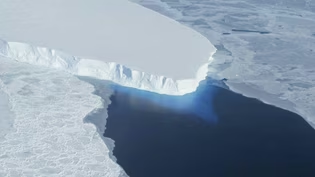
AMNA NAWAZ: And we report from atop a glacier in Antarctica that's melting faster than any other on Earth.
MILES O'BRIEN: This glacier alone represents about 2.5 feet of sea level rise all over the world.
(BREAK) AMNA NAWAZ: Welcome to the "News Hour."
The Trump administration's top immigration enforcement official says massive changes are coming to Minnesota, including plans to eventually pull out some of the thousands of federal agents currently deployed there.
GEOFF BENNETT: And despite the administration's plan to ease some of the tensions, state and local officials and even the courts are demanding bigger changes.
After weeks of tension, protests and clashes in the Twin Cities and the shooting deaths of two U.S.
citizens by federal immigration agents, Tom Homan, President Trump's border czar, today said he's working on a possible drawdown plan in Minnesota, and he acknowledged missteps.
TOM HOMAN, White House Border Czar: Yes, I said it, draw down the number of people here.
Nothing's ever perfect.
Anything can be improved on.
And what we have been working on is making this operation safer, more efficient, by the book.
GEOFF BENNETT: But, Homan added, any reduction in the roughly 3,000 federal officers in Minnesota would only come with cooperation from state officials, which Homan acknowledged was occurring.
And he said there would be zero tolerance for protesters who assault or interfere with officers.
TOM HOMAN: We are not surrendering the president's mission on immigration enforcement.
Let's make that clear.
As we see that cooperation happen, then the redeployment will happen.
GEOFF BENNETT: It comes as new video surfaced of Alex Pretti, one of the two U.S.
citizens killed in Minneapolis by federal agents.
In the video taken 11 days before Pretti was shot and killed, he's seen kicking the taillight off a federal vehicle before agents tackle him to the ground.
President Trump reposted the video on social media last night.
But in a meeting with his Cabinet today... QUESTION: Mr.
President, why not take questions?
GEOFF BENNETT: ... the president refused to discuss Minnesota entirely, took no questions, and notably did not call on Homeland Security Secretary Kristi Noem to speak.
That's as some Republican lawmakers have called for ICE to refocus on its core mission.
Ohio Senator Jon Husted: SEN.
JON HUSTED (R-OH): It's time to reset and focus on what the mission is, which was to target violent criminals, people who are on the worst-of-the-worst list.
GEOFF BENNETT: Meantime, from one state drawdown to another.
Republican Senator Susan Collins said today that enhanced immigration operations in her state of Maine have ended.
That's after ICE today revealed its enforcement surge there culminated in more than 200 arrests.
In a statement, Collins said she urged Secretary Noem to get ICE to reconsider its approach to immigration enforcement in the state.
The courts have also demanded reforms for ICE.
The federal chief judge in Minnesota condemned immigration agents and officials there for violating nearly 100 court orders this month alone.
Another federal judge ordered the Trump administration to stop detaining and deporting Minnesota refugees who were lawfully admitted to the U.S.
Speaking to fellow mayors in Washington, D.C., today, Minneapolis Mayor Jacob Frey held firm that the only reduction in federal agents that he will accept is a total reduction.
JACOB FREY (D), Mayor of Minneapolis, Minnesota: We've been very clear.
The Operation Metro Surge needs to end.
This kind of conduct and siege needs to stop, not just in Minneapolis.
It needs to stop nationwide.
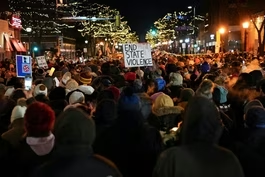
GEOFF BENNETT: Back in the Twin Cities, a vigil for Alex Pretti, an ICU nurse mourned by colleagues, neighbors and fellow medical professionals.
PROTESTERS: Say his name!
GEOFF BENNETT: Solemn calls for justice in a city still very much on edge.
For more on the legal and constitutional questions surrounding the unrest in Minnesota, we're joined now by Paul Butler, a former federal prosecutor who now teaches criminal law at Georgetown University's Law Center.
Thanks for being here.
PAUL BUTLER, Professor, George University Law Center: It's great to be with you.
GEOFF BENNETT: We heard President Trump's border czar, Tom Homan, say that federal officials could start drawing down operations in Minnesota so long as the state and local governments comply with the federal enforcement.
Are Minnesota officials actually legally obligated to comply with the federal government when it comes to immigration enforcement?
PAUL BUTLER: They're not legally required by the Constitution, but Minnesota state law requires the state prison to release inmates who are subject to deportation to ICE after they've served their sentence.
So, last year, about 84 inmates went from state prison in Minnesota to ICE custody.
GEOFF BENNETT: When we hear Tom Homan talk about targeted enforcement, what does that actually mean?
PAUL BUTLER: It means, he says, going after people who are undocumented and threats to national security or public safety.
If Homan follows through, that could be a gang changer from what the administration's strategy now is, which is mass deportations.
There's no way that you can deport or detain 3,000 people a day without bad optics.
It inevitably involves racial profiling, brief detentions of people who are legally in this country to ascertain that they're citizens.
So targeted enforcement is not flashy, and there'll be a lot fewer people detain.
The statistics suggest that people who are undocumented are actually less likely to commit violent crime than people who are here in this country legally.
So you wouldn't have the big numbers, but, arguably, there'd be more of a benefit to public safety than just randomly rounding up people on the streets.
GEOFF BENNETT: We've also seen protesters and legal observers say that they've been swept up in these enforcement actions.
What legal protections do people observing these enforcement actions, do journalists, do bystanders have in these situations?
PAUL BUTLER: So, there's two parts of the Constitution that are relevant.
People have a Fourth Amendment right to be free of unreasonable searches and seizures.
The ACLU has a lawsuit in which it says a number of protesters and observers have been illegally detained.
They haven't committed any crime, but they've still been swept up in this enforcement effort.
And there's also a First Amendment right that everybody has to protest.
You can't impede law enforcement, but you can be annoying.
You can yell and curse at officers, you can blow whistles at them.
You just can't obstruct them from carrying out their law enforcement responsibilities.
GEOFF BENNETT: Federal agencies, including ICE and Border Patrol, there are reports that those agencies are using the same intrusive technologies, whether it's biometric technology, facial recognition technology, to not only track undocumented immigrants, but increasingly to track citizens opposed to the government's actions.
What legal questions does that raise?
PAUL BUTLER: So it raises questions about whether the government is using new technology in ways to circumvent the warrant requirement or the law that says that people can't be detained unless the government has reasonable suspicion.
So what ICE and Customs is doing is using, say, facial recognition techniques to identify protesters and possibly to identify people who are in the country without documents.
Now, if they're in public, they don't have any right not to have their identity known.
But there are always concerns about, if it's protesters, people who are acting legally, of why the government is doing this.
And there have been reports that ICE agents have identified protesters, and then in some instances driven their vehicles to their homes and just kind of announced their presence, not necessarily gone into the house.
Some protesters have understandably found that intimidating.
GEOFF BENNETT: At the moment, are the courts the only backstop, the only guardrail to prevent the abuse of power or the unconstitutional actions by the federal government, especially in places like Minneapolis and in blue cities and blue states?
PAUL BUTLER: So there are concerns about accountability, about when federal agents cross the line if there will be consequences.
There are also concerns about the ways that the federal officers are implementing immigration enforcement in Minneapolis.
They're often wearing masks.
They don't identify themselves.
And many of them don't use body cams.
So Congress could pass a law requiring masks, requiring identification in most instances, and also requiring body cams.
That would go a long way in terms of assuring people in Minnesota that the law enforcement officers are acting in a responsible way.
And if they're not, then they can be identified, so that there could be consequences either within ICE or in some instances, if they cross a line, criminal consequences.
GEOFF BENNETT: Paul Butler, thanks, as always, for your insights.
PAUL BUTLER: Always a pleasure.
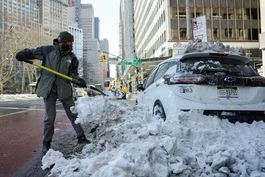
AMNA NAWAZ: In the day's other headlines: National weather officials are warning of dangerously cold temperatures across large parts of the Eastern U.S.
heading into the weekend.
Winter advisories were in effect today for areas stretching from Texas to Maine.
Some states in the South Atlantic could see more heavy snow starting tomorrow.
In the meantime, emergency crews have been working to repair icy power lines in Mississippi, in one case even using a helicopter to access those lines.
The state also dispatched the National Guard to help clear the roads five days after a massive storm, while, in Nashville, more than 100 people lined up outside this church to stock up on food items.
The death toll from the frigid weather has now risen to at least 85 people.
President Trump says he asked Russian President Vladimir Putin not to strike Ukraine's capital for a week due to the frigid weather there.
Ukraine has been experiencing one of the coldest winters in years, and Russian strikes have repeatedly knocked out heating for thousands.
Speaking during his first Cabinet meeting of the new year, President Trump said Putin agreed, though the Kremlin has not confirmed that.
DONALD TRUMP, President of the United States: And I have to tell you, that was very nice.
A lot of people said, don't waste a call.
You're not going to get that.
And he did it.
And we're very happy that they did it.
MAN: That's correct.
DONALD TRUMP: Because, on top of everything else, it's not what they need is missiles coming into their towns and cities.
So... AMNA NAWAZ: The president also said he's ordered Venezuela's airspace to reopen to commercial traffic, saying that Americans will soon be able to visit.
Venezuela's government has not yet commented.
Soon after the announcement, American Airlines said it would aim to restart service in the coming months.
The carrier was the largest U.S.
airline in Venezuela before flights were suspended in 2019.
Meanwhile, in Venezuela today, lawmakers approved the opening of the nation's oil sector to privatization.
(APPLAUSE) AMNA NAWAZ: The National Assembly's decision would ease state control and reverse a key principle of the country's socialist movement that's ruled Venezuela for over two decades.
It also comes after President Trump said the U.S.
would take control of Venezuela's oil exports with plans to revitalize the industry by attracting foreign investment.
The European Union has listed Iran's Revolutionary Guard as a terrorist organization following Tehran's violent crackdown on protests that left thousands dead.
This puts the E.U.
in line with the U.S.
and Canada, which have already designated the group as such.
Iran's foreign ministry slammed the designation as -- quote -- "illegal and unjustified."
The 27-nation bloc also sanctioned 21 Iranian officials and organizations today.
The E.U.
's foreign policy chief said -- quote - - "Repression cannot go unanswered."
KAJA KALLAS, Foreign Affairs High Representative, European Commission: The means that were taken by the regime are really, really severe.
So that's why we are also sending a clear message that, if you are suppressing people, it has a price.
AMNA NAWAZ: Activists say Tehran's crackdown on protesters has killed more than 6,400 people.
Also today, Iranian state media is reporting that the country will carry out live-fire shooting drills in the Strait of Hormuz next week.
That could disrupt traffic in the waterway, where about 20 percent of the world's oil passes through.
In Illinois, a former sheriff's deputy was sentenced to 20 years in prison today for fatally shooting Sonya Massey, a Black woman who called 911 for help; 31-year-old Sean Grayson, who is white, apologized during the sentencing, saying -- quote -- "I made terrible decisions that night.
I'm sorry."
Grayson and another deputy responded to Massey's home in July of 2024 after she reported a possible intruder.
Grayson shot Massey as she held a pot of boiling water.
The killing prompted protests over systemic racism during police encounters.
Gymnast Jordan Chiles is one step closer to potentially reclaiming a disputed bronze medal from the 2024 Paris Olympics.
The highest court in Switzerland has sent the case back to the Court of Arbitration for Sport to examine new evidence.
Chiles' third place finish on floor exercise was hastily overturned after Romania claimed the Americans didn't file a score challenge in time by a matter of seconds.
Today's ruling cited audio-visual recordings of the final, which could change the outcome, though it's expected to take at least a year before a verdict is ready.
The U.S.
trade deficit widened by the most in more than three decades in November.
That's according to data out today, which was delayed by the government shutdown.
The latest figures represent a sharp pivot from prior months, when the deficit had shrunk amid President Trump's tariffs.
Economists say the data also points to ongoing volatility in global trade.
In the meantime, on Wall Street today, stocks ended mixed after a dramatic day of ups and downs.
The Dow Jones industrial average managed a slight gain of around 55 points.
The Nasdaq lost more than 170 points.
The S&P 500 ended a touch lower on the day.
Twenty-five classic movies are entering the National Film Registry at the Library of Congress.
And fans of a certain age will be totally bugging about one of those.
ALICIA SILVERSTONE, Actress: Ew, get off of me.
As if.
AMNA NAWAZ: The iconic '90s comedy "Clueless" made this year's list.
Like the others, it was selected for preservation due to its -- quote - - "cultural, historic or aesthetic importance."
The newest film to be included was Wes Anderson's "Grand Budapest Hotel" from 2014 and the oldest, a silent film, "The Tramp and the Dog," which dates back to 1896.
Four documentaries also made the cut, including 1981's "Brooklyn Bridge" by Ken Burns.
And social media star and nonprofit founder Shirley Raines has died.
SHIRLEY RAINES, Nonprofit Founder: Hey, my love.
How are you?
MAN: All right.
I'm doing good.
How are you?
SHIRLEY RAINES: Good to see you, baby.
MAN: Thank you.
AMNA NAWAZ: Known to millions on TikTok simply as Ms.
Shirley, Raines helped to feed and care for homeless people on Skid Row in Los Angeles and elsewhere in California and Nevada.
She began the work in 2017 following the death of one of her six children.
Her organization Beauty 2 The Streetz says Raines -- quote -- A"used her powerful media platform to bring dignity, resources and hope to some of the most underserved populations."
No cause of death was announced.
Shirley Raines was 58 years old.
Still to come on the "News Hour": Congress works to avoid another government shutdown; we report from Antarctica on a scientific expedition to understand climate change; and Walmart heiress Alice Walton founds a nonprofit medical school blending traditional education with art.
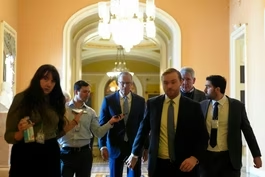
Well, senators are racing to find a solution, as the federal government is once again on the verge of a partial shutdown.
This time, there's hope for a bipartisan deal on the key issue, the conduct of ICE and other DHS officers.
Congressional correspondent Lisa Desjardins has been following it and is here with the latest.
So, Lisa, a day away from another partial shutdown, where do things stand?
LISA DESJARDINS: We have news.
We have breaking news, in fact.
Per multiple sources, there is a deal on the table now between Republicans and Democrats.
As I speak to you, what's happening in the U.S.
Senate, they're going through a process called hotlining, meaning especially Republican senators, they go along with a fast-track vote on all of this as soon as tonight.
So let's talk about what's in this potential deal, first of all.
OK, now, this would fund the five agencies involved that need funding, all but DHS, for full funding for the rest of the fiscal year.
DHS would be taken out and it would get two weeks of funding instead, a short-term funding deal for DHS for two weeks.
That would allow then, in the meanwhile, time for lawmakers to work out a potential deal on ICE and DHS conduct.
Now, this is a breakthrough.
And I am told that the White House has been part of this negotiating all along, so we think the president is on board as well.
But there are still issues ahead of this.
This is not necessarily easy.
First of all, some Senate Republicans do have concerns, are skeptical about the spending, including earmarks, in this package and how ICE is treated.
In addition, there is Speaker Johnson.
His office confirms to me that he has concerns about this short-term Homeland Security fix.
Now, at the same time, the House is not even in session, Amna.
And I don't need to remind you and our viewers, but I will.
The deadline is tomorrow.
So all of this needs approval not just by the Senate, but also by the House.
So let's imagine a best-case scenario.
The Senate passes this deal tonight.
That's still not sure, but tonight or tomorrow.The House still has to do it.
So, right now, we will have a partial government shutdown, at least over the weekend.
And we don't know how much farther than that.
It depends a lot about when the House can come back and if this deal does get through the Senate.
AMNA NAWAZ: OK, so a possible deal, some signs of hope, but still a potential partial shutdown over the weekend.
Walk us through what that looks like.
LISA DESJARDINS: Yes, let's remind people, first of all, Congress already passed funding for itself, for parks and a slew of agencies, but 70 percent of what it governs is still waiting for funding.
So let's take a look at exactly what that means.
This is the list, a lot of big agencies, Homeland Security, Defense, HHS.
The hope, of course, is that most of these would be funded and, again, DHS would be taken out of the package for its own bill.
So what would a partial shutdown mean for Homeland Security?
You may be surprised.
ICE, for example, is already funded.
So is CBP by a surge in funding that happened last summer.
How about the other parts of Homeland Security?
Look at that.
FEMA, that has reserves.
TSA, and also the Coast Guard, those agents, people working for those agencies are paid until February 13.
So what's the bottom line here?
It's good news for these agencies and that any shutdown weekend or more would be a minimal effect shutdown.
But it sort of takes pressure off of lawmakers, but important for all these agencies to know where they're at.
AMNA NAWAZ: Meanwhile, Lisa, you reported on the shift you have heard among senators on working towards a deal.
This is a big shift for the White House, for President Trump to want to work towards compromise and a deal.
What's your reporting on why?
LISA DESJARDINS: This takes us back to other times, where you would see a White House engaging and sort of open to compromise in a way that we haven't seen from this Trump administration.
Yes, I think it's the reality on the ground that mattered, the videos of Americans and how they were treated, especially Alex Pretti.
And, today, I think we heard about -- from Democrats constitutional questions.
House Democratic Leader Hakeem Jeffries brought up this idea that search and seizure protections had been on the line and affected Republicans as well.
REP.
HAKEEM JEFFRIES (D-NY): These extremists seem to believe that the Fourth Amendment does not apply to DHS enforcement activity.
They have lost their minds.
And the American people know it.
LISA DESJARDINS: Now, where we are tonight, of course, is that we're hoping for this deal or many who are on board want this deal for funding.
If they get this deal, then we will have a two-week conversation about what needs to happen with ICE and DHS themselves.
And we know that will be, again, a hard conversation.
AMNA NAWAZ: Very big thanks to you, Lisa, and a very happy birthday to you as well on this day.
LISA DESJARDINS: Oh, thank you very much.
AMNA NAWAZ: Lisa Desjardins.
LISA DESJARDINS: It's a birthday miracle.
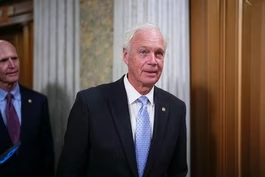
(LAUGHTER) GEOFF BENNETT: Well, for a Republican perspective on all of this, I spoke earlier with Senator Ron Johnson of Wisconsin before the latest announcement of a deal.
Senator Ron Johnson, welcome back to the "News Hour."
SEN.
RON JOHNSON (R-WI): Thanks for having me on.
GEOFF BENNETT: President Trump sounded positive today about the possibility of avoiding a government shutdown, saying that he's engaged in talks with Democrats.
You were among the Republicans who joined with Democrats in voting to block the funding legislation from advancing.
Why?
SEN.
RON JOHNSON: Well, I'm just basically thoroughly disgusted with the process.
I have been here 15 years.
We should have passed in that time frame 180 appropriation bills on time before the start of the fiscal year in which they were funding.
We have passed six.
That's a 96.7 percent failure rate.
To address that, I propose and we voted on the Eliminate Shutdown Act.
We get rid of this dysfunction for all time.
Pretty simple bill, just rolling a 14-day automatic appropriations until the appropriators can come to agreement to pass appropriation bills, short of that, the Shutdown Fairness Act.
Let's at least pay these people.
We're going to do it after the fact.
Let's pay them on time.
Neither bill has been passed yet.
Throw on top of that this package, in order to get it passed, includes $14.3 billion worth of earmarks.
I'm part of the Republican Senate Conference.
We have a resolution against earmarks.
We're in charge.
We have got the chairmanship of the committee and we're going to allow $14.3 billion of earmarks when we're approaching $39 trillion in debt.
So, by and large, I'm just disgusted by the process.
Other people can pass it.
I'm not going to participate.
GEOFF BENNETT: Why isn't there a greater will on Capitol Hill to avoid governing by brinksmanship?
SEN.
RON JOHNSON: Because this is the way it's been done.
This dysfunction is accepted.
The uniparty appropriators like the fact they have these government shutdowns to create leverage for their passing of bills that we can't afford.
Again, let me -- we're approaching $39 trillion in debt.
Now, I realize discretionary spending is only about a quarter of all spending, but earmarks are the gateway drug.
When I first got here in 2011, this was a big debate between Tom Coburn and Jim Inhofe, the two senators from Oklahoma.
And Senator Inhofe made some good points.
You can't let all the spending decisions up to just the president.
But I sided with Tom Coburn that these earmarks are literally the gateway drug that greases the skids.
We were $14 trillion in debt back in 2011.
Now we're approaching $39 trillion.
The system is completely out of control, completely broken.
Somebody got to stand up here and point that out and just vote no every now and again.
GEOFF BENNETT: Democrats in these talks are calling for reforms to the way that ICE operates.
They're calling for the wearing of body cameras, no wearing masks, tightening the use of warrants.
Are any of those things that you can support?
SEN.
RON JOHNSON: Well, first of all, they're trying to basically take the focus off of the root cause of problem, which is their open border policy, the fact we flooded millions of people into this country, a significant number of murderers and rapists and gang members, members of transnational criminal organizations, drug human and sex traffickers.
They concentrate on the martyrs that they have created by encouraging their supporters to go out and obstruct justice, resulting in the tragic deaths of two individuals in Minnesota.
So they don't want people to take a look at the real problem, which is the massive problem they caused with their open borders.
They want to focus now on DHS and blame DHS, the very people that are charged with trying to clean up their enormous mess.
GEOFF BENNETT: But even the administration is taking a different view.
You had Tom Homan today.
He publicly acknowledged that federal immigration enforcement in Minneapolis, in his words, hasn't been perfect and that certain improvements could and should be made to how ICE and federal agents are operating there.
At the same time, there's a new FOX News poll that shows 59 percent of registered voters now say that ICE's deportation efforts have been too aggressive.
So, given that, isn't there an acknowledgement, even within the administration, that more needs to be done to balance immigration enforcement and public safety?
SEN.
RON JOHNSON: Well, again, I know I want -- I know you want to focus on the problems that we have had trying to clean up the mess.
But I, for one, have a great deal of sympathy for an ICE officer.
How would you like to be somebody conducting legal law enforcement activity, and you have got the lieutenant governor of the state of Minnesota managing a Signal chat so they're encouraging their protesters to surround ICE officers?
They're under threat.
They're being doxxed.
They're having their vehicles rammed by these peaceful protesters' vehicles.
So, yes, ICE officers are under hair-trigger alert, which has resulted in those tragic deaths.
So I have got a great deal of sympathy for the ICE officers who are being put in this position.
They're trying to keep America safe.
They're trying to keep Minneapolis safe.
And they're being frustrated and obstructed in those efforts.
GEOFF BENNETT: Some of your Republican colleagues, to include Senator Lisa Murkowski, Thom Tillis, they're now calling for the homeland security secretary, Kristi Noem, to step down.
The president notably did not call on her at today's Cabinet meeting when he was going around the table.
You said that she got over her skis in her initial comments about the shooting death of Alex Pretti.
Drawing on your experience as the former chair of the Senate Homeland Security Committee, do you believe that she deserves to stay in the job?
SEN.
RON JOHNSON: I believe that's the president's call.
I will leave it up to him.
GEOFF BENNETT: You don't have a view on it?
SEN.
RON JOHNSON: I will leave it up to the president.
Again, they serve at his pleasure, and that's his call.
GEOFF BENNETT: Senator Ron Johnson, thanks for your time.
SEN.
RON JOHNSON: Have a good evening.
AMNA NAWAZ: Trade deals around the world are being negotiated, signed and celebrated without the U.S.
Leaders are looking to other sources of economic partnership, as turbulent tariff policies, harsh rhetoric and unpredictable social media posts from President Trump push allies to the edge.
Nick Schifrin has this report.
NICK SCHIFRIN: This is not the pivot to Asia the U.S.
intended.
Today, the first British prime minister visits to Beijing in eight years, and Keir Starmer told Chinese President Xi Jinping he wanted a lasting relationship.
KEIR STARMER, British Prime Minister: I have long been clear that the U.K.
and China need a long-term, consistent and comprehensive strategic partnership.
NICK SCHIFRIN: The person who must not be named, President Trump, only referenced in passing by a Chinese leader who presented himself as a source of stability.
XI JINPING, Chinese President (through translator): Currently, the international situation is intertwined with changes and turmoil.
As long as we uphold a broad historical perspective, transcend our differences and respect each other, we will be able to deliver results that can withstand the test of history.
NICK SCHIFRIN: It's not the first time in history a British delegation has visited Beijing to make business deals.
But it comes despite British criticisms that China is a threat to national security.
KEMI BADENOCH, British Conservative Leader: Cybersecurity, stealing intellectual property.
Keir Starmer doesn't really know how to deal with China.
My worry is that he's going there with a begging bowl.
NICK SCHIFRIN: But more European leaders are walking the Chinese red carpet.
Earlier this week, it was Finland's prime minister, Petteri Orpo.
PETTERI ORPO, Prime Minister of Finland (through translator): China-Finland relations have developed steadily regardless of changes in the international situation.
NICK SCHIFRIN: Those changes have pushed Europe into Asia's arms.
URSULA VON DER LEYEN, President, European Commission: We did it.
We delivered the mother of all deals.
NICK SCHIFRIN: This week, the European Union and India finalized a deal that represents a third of global trade.
And, today, Europe upgraded its ties with Vietnam, as European Council President Antonio Costa warned of changing tides.
ANTONIO COSTA, President, European Council: hat the moment when international rules-based order is under threat from multiple sides, we need to start to stand side by side as reliable and predictable partners.
DONALD TRUMP, President of the United States: We have helped them for so many years.
We have never gotten anything.
NICK SCHIFRIN: It was only last week that President Trump proved himself unpredictable over Danish territory Greenland and disparaged the very concept of NATO's collective defense.
DONALD TRUMP: And all we're asking for is to get Greenland, including right, title and ownership, because you need the ownership to defend it.
You can't defend it on a lease.
NICK SCHIFRIN: The European response has been visceral.
KAJA KALLAS, Foreign Affairs High Representative, European Commission: Europe is no longer Washington's primary center of gravity.
The shift has been ongoing for a while.
It is structural, not temporary.
It means that Europe must step up.
No great power in history has ever outsourced its survival and survived.
MARK CARNEY, Canadian Prime Minister: We are in the midst of a rupture, not a transition.
NICK SCHIFRIN: Western doubt in the U.S.
most publicly expressed by Canadian Prime Minister Mark Carney, who recently made his own automotive trade deal in Beijing, despite a threat from President Trump.
MARK CARNEY (through translator): The world has changed.
Washington has changed.
Almost nothing is normal in the United States at the moment.
That is the truth.
NICK SCHIFRIN: But Canada and Europe still rely on the U.S.
for security, natural gas and oil.
And the trading relationship is worth more than $5 trillion, all of which pointed out this week by NATO Secretary-General Mark Rutte.
MARK RUTTE, NATO Secretary-General: If anyone thinks here, again, that the European Union or Europe as a whole can defend itself without the U.S., keep on dreaming.
You can't.
In that scenario, you would lose the ultimate guarantor of our freedom, which is the U.S.
nuclear umbrella.
So, hey, good luck.
NICK SCHIFRIN: The hard reality of Europe's present, but they're considering a more independent future thanks to doubts sowed by President Trump.
For the "PBS News Hour," I'm Nick Schifrin.
AMNA NAWAZ: Well, to help us understand the implications of these shifting global relationships, I'm joined now by Chrystia Freeland, the former deputy prime minister and former foreign affairs minister of Canada.
Chrystia, welcome back to the "News Hour."
Thanks for joining us.
CHRYSTIA FREELAND, Former Canadian Deputy Prime Minister: Great to be with you.
AMNA NAWAZ: So, before I ask you specifically about Canada, I want to get your big picture view on those new deals we just reported on, the E.U.
with India and Vietnam, Britain and China.
How do you see those?
Are those a response to or a backlash to President Trump's tariff threats and other threats against NATO allies?
CHRYSTIA FREELAND: Yes, I think, in part, they are.
I mean, I think those deals -- and I think the really important one is the E.U.-India deal.
Ursula von der Leyen, the president of the European Commission, described that deal as the mother of all deals.
Maybe a bit of an exaggeration, but it's really, really significant.
That's an agreement between two really big economies.
And, traditionally, it's quite hard to do a trade deal with India.
I'm a former trade minister, and it takes a long time to negotiate with the Indians.
They're very professional, very careful, very thorough.
So the fact that they signed that deal, very, very significant, and I think it's a good thing for the world.
AMNA NAWAZ: In terms of dealing with China here, I do want to put to you what the E.U.
's climate chief said today.
He said the E.U.
should resist China's pull on clean tech.
In particular, he warned about economic coercion, also warned about potential kill switches in the technology that could threaten the E.U.
's energy system.
And I should note that Canada just signed a deal to allow thousands of Chinese electric vehicles into the country at a new lower tariff rate.
So does Canada not share those same security and economic concerns?
CHRYSTIA FREELAND: Look, I think the China question is a really important one.
And when I was finance minister, I actually put in place tariffs on Chinese cars, tariffs on Chinese steel and aluminum, matching the tariffs that the Biden administration had put in place.
And we put those tariffs in place because we recognized the security challenges from China, because we recognize the need to protect our workers, Canadian manufacturing workers, from Chinese intentional oversupply.
But we also did it because of our partnership with the United States.
And we wanted to be a good friend and a good ally.
It's hard to have those friends, though, when countries are feeling pressure from the United States, including tariffs from the United States.
AMNA NAWAZ: So if we see this as part of a Canadian effort to pivot slightly away from the United States then, for Canada specifically, I mean, the two economies are so integrated, right?
For every two out of every three Canadian exporters, the U.S.
is the sole market.
So how difficult is it going to be for Canada to pivot away?
CHRYSTIA FREELAND: Look, I think diversification is always a good idea.
Whether you are a business or a country, to rely on a single client is - - a single customer, is never a great idea.
But what I'd also like to take the opportunity to say tonight to all of your American viewers is, we want to be your friends.
I think the vast majority of Canadians would prefer a close, effective, mutually beneficial relationship with the United States, including on trade.
And I know that's possible.
I am the person for Canada who negotiated the USMCA, the new NAFTA trade agreement.
We negotiated that with the first Trump administration.
There were a lot of bumps along the way.
Tariffs were imposed on Canada at one point.
We responded with dollar-for-dollar retaliation.
But, at the end of the day, we got to a deal.
And we got to a deal that President Trump described as the best trade deal ever.
AMNA NAWAZ: And yet despite the long alliance between the two countries, we saw the Canadian prime minister, Mark Carney, in Davos talk about us being in a time of rupture.
He mentioned the old order is not coming back.
Do you see what's happening now as the beginning of a new world order?
And what does that look like to you?
CHRYSTIA FREELAND: I think a lot of countries, a lot of America's traditional allies are finding their current treatment to be really challenging.
I was at Davos.
One of the comments that struck me the most was actually from the prime minister of Belgium.
Now, he is a conservative.
He is part of the right-wing group in the E.U.
He is an Atlanticist.
He is the kind of person who traditionally would be a great ally of the United States.
And he said being a happy vassal is one thing.
Being a miserable slave is something else.
So, when a phlegmatic Flemish Belgian prime minister is describing the way he is being treated, the way his country is being treated as being treated like a miserable slave, I think you know that America's traditional allies are feeling ill-treated.
And countries are responding.
AMNA NAWAZ: You mentioned that U.S.-Mexico-Canada trade agreement you helped to negotiate.
That is set to be reviewed by this summer.
What happens if the U.S.
pulls out of that?
CHRYSTIA FREELAND: I think that would be devastating for the U.S.
economy.
And one of the things that I think we have observed over the past few weeks is, when there is a strong market reaction, we see that this administration is able to course-correct.
When the threats about Greenland were at their peak, you did see markets reacting negatively.
And shortly after that, you saw a softening of the U.S.
position.
I ultimately believe that market signals, also what the administration hears from American states, from American mayors, from American legislators, from all of the Americans who sell to Canada, I think that is ultimately going to mean that we get to a deal.
AMNA NAWAZ: That is the former Deputy Prime Minister of Canada Chrystia Freeland joining us tonight.
Thank you so much for your time.
It's good to speak with you.
CHRYSTIA FREELAND: Pleasure.
GEOFF BENNETT: A two-month-long expedition to Antarctica has brought scientists and researchers to the widest glacier on earth, the Thwaites Glacier.
It's also nicknamed the Doomsday Glacier because of its potential impact to raise sea levels if ice continues to melt.
Our science correspondent, Miles O'Brien, is on that trip.
The primary challenge for many of the researchers, they're trying to drill a small hole on the glacier at the place where ice, land and the sea meet some 3,000 feet below, the so-called grounding line.
The instruments they drop into the seawater could yield unprecedented data.
Miles has been visiting the base camp today and has this look at the challenges of what they're doing, part of our recurring series Tipping Point.
MILES O'BRIEN: So, how do you drill a hot water hole into a glacier 3,000 feet?
Well, the first thing you need is a lot of hot water.
And, fortunately, there's a pretty much never-ending source of snow here.
Behind me, these are called flubbers.
The team here, there are 10 people here, had to shovel over the course of the past week or so 20 tons of snow into those containers.
They are truly practicing oceanography the hard way.
It's hard work.
The weather was terrible, but they got what they needed to do this hot water drill hole.
Let's take a look at what else is going on here.
OK, so shoveling 20 tons of snow is just for starters.
You got to melt it.
So those three boxes over there, those are generators.
They're connected to those three boxes with heaters.
There's two, four, six of them.
That turns the snow into water at 194 degrees Fahrenheit.
It gets sent through this black hose.
This is the key drilling hose on that black spool and it goes down the hole.
There are two other spools there that are very important.
The orange spool, which they're using right now, is how you drop down instruments that don't need to communicate with the surface, things like cameras and so forth.
The silver spool right there, that's coaxial cable.
It can carry data.
So if you have an instrument where you want to keep reading the data as it goes down, you use that.
Hard to believe 3,000 feet below where I stand, we're actually floating on the Amundsen Sea, but this is how you get all the scientific instruments, get the data that scientists are so interested in finding about why this glacier is melting so quickly.
This is the science tent.
This is the stuff that's going down the hole.
And everything here has to be working before they begin drilling, so I don't want to touch anything.
I'm going to sit down here and be very careful not to break anything.
Basically, they will be sending down instruments that measure the salinity, the temperature, the current of the water, the sedimentary picture.
And here's what's kind of cool.
This tower is part of a structure that will be left here with instrumentation all the way down through the glacier to the Amundsen Sea, so that scientists will be able to get real-time data continuously for hopefully a number of years on what's going on here.
What are the temperatures?
What is happening beneath this glacier?
Why is it melting so quickly?
GEOFF BENNETT: And Miles O'Brien joins us now from the Thwaites Glacier.
So, Miles, how's it going there?
I know there's limited time to get this work done.
MILES O'BRIEN: Yes, this is truly deadline pressure stuff, Geoff.
You and I can relate to it in our business, but they are truly under the gun, and they have run into a little bit of a snag.
As you can -- might be able to tell right here, they're working on the end of the drill hose right behind me with a crescent wrench.
About 30 feet beneath the surface as they went down, they encountered crevasse and -- essentially an open cavern which extends down about 20 or 30 feet and then it goes back into solid snow.
So you have got this open space.
And you can imagine drilling a hot water hose down and all of a sudden you're in this cavern.
How are you going to keep the hose from wobbling, and how do you get the instruments to connect with the hole at the bottom of the cavern, so to speak?
So they're kind of running through this.
They have never run into this before because they have always drilled in places that were more benign.
But this glacier is collapsing so rapidly that the crevasses are everywhere.
So they sort of expected to run into them.
But this is taking their drilling technique and technology to a new level, Geoff.
GEOFF BENNETT: And, Miles, remind us what they're measuring for and why.
MILES O'BRIEN: Well, the Thwaites Glacier is melting orders of attitude, several times more faster than its neighbors here in Antarctica.
And scientists are pretty certain that it's being eaten away from beneath by warm currents in the Amundsen Sea.
There's a whole climate change connection to that has changed the wind currents around Antarctica, which has allowed this warm water to really be 3,000 feet beneath where I stand right now well above freezing.
And so the question is, how much more above freezing is it?
How -- what are the currents there?
What is the nature of the melt right now?
And by doing this and getting this data, they can actually come up with good predictions, models and forecasts for what happens here and to other glaciers in this vicinity.
They may not be melting as rapidly, but Thwaites is sort of a keystone which holds them back.
And this glacier alone represents about 2.5 feet of sea level rise all over the world.
The other glaciers added up about 10 feet.
So it's worth paying attention to.
GEOFF BENNETT: So what happens from here?
Where are the next steps?
MILES O'BRIEN: Well, they got to figure out how to get through this crevasse and make sure that all the instruments that go through that open space.
I'm sure they will figure that out.
But the clock is ticking.
They only have so much fuel to keep those heaters going, keep the snow, turning it into hot water.
And the ship has to leave for New Zealand at -- last day of work here is February 7.
So they're under the gun to get this done.
They need about three days of drilling and science operations, so into the weekend.
And, hopefully, they will get through this little obstacle right now and, by the end of the weekend, they will have made a little bit of scientific history.
GEOFF BENNETT: And, Miles, can I ask you what it feels like atop the glacier there?
What's the temperature?
MILES O'BRIEN: It's down low 20s.
But I got to tell you, Geoff, the wind here has a quality which is very distinct coming off the ice.
When you feel the wind, it just cuts right through you.
So I am well bundled up, as you can see.
But we know every moment that we are in Antarctica.
GEOFF BENNETT: Yes, I was going to say, we're dealing with low 20s here on the East Coast, but certainly not glacial winds.
(CROSSTALK) GEOFF BENNETT: So, Miles O'Brien, our best to you and the team there in Antarctica.
Thanks, as always.
MILES O'BRIEN: You're welcome, Geoff.
AMNA NAWAZ: Well, a painting certainly can't help fix America's health care system, but it might help the healers themselves.
That's one idea behind a new medical school in Arkansas.
Senior arts correspondent Jeffrey Brown traveled there to speak with Alice Walton, who created and funded this effort.
For the record, the Walton Family Foundation is a funder of the "News Hour."
The piece is part of our coverage of the intersection of health and arts, part of our Canvas series.
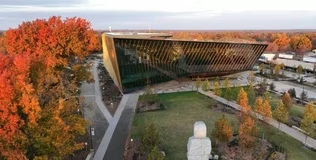
JEFFREY BROWN: A sprawling 134-acre campus in Bentonville, Arkansas, the 14-year-old Crystal Bridges Museum of American art, the 6-year-old Heartland Whole Health Institute, and a brand-new medical school with a design evoking the local Ozark geology.
Bringing art, health, and education together is the goal of the woman behind it all, Alice Walton.
ALICE WALTON, Founder, Alice L. Walton Medical School: We can collide these wonderful industries and wonderful people and really let them learn from each other and figure it out.
JEFFREY BROWN: Health, art, put them together?
ALICE WALTON: Yes, yes, collide.
I like the collision.
(LAUGHTER) JEFFREY BROWN: Strong door.
Walton, an heir to the Walmart fortune, is one of the world's richest individuals.
ALICE WALTON: Here we go.
JEFFREY BROWN: But here she drives herself around in her own little putt-putt.
ALICE WALTON: It only goes 25 miles and a half or so.
I can't exactly speed.
JEFFREY BROWN: You're not too dangerous.
ALICE WALTON: I'm not too dangerous, I don't think.
JEFFREY BROWN: One area where Walton is trying to cause some trouble, the nation's health care system, now by creating the Alice L. Walton school of medicine, known by its acronym, AWSOM, not a word she would use to describe health care today.
ALICE WALTON: The real problem with health care is that there's no incentive in the payment system for doctors to spend time helping you learn what good nutrition is, how important exercise is.
And, frankly, doctors aren't taught those things because they're not paid for those things.
JEFFREY BROWN: So that means the medical education system is... ALICE WALTON: Is faulty.
It is focused on let people get sick and we will fix you.
So what we're trying to do is, yes, our docs will be allopathic docs.
They will know how to fix you, but they will know how to keep you healthy.
JEFFREY BROWN: It's starting out small and offering free tuition to the first five classes.
The 48 students in the school's first group take traditional science-based and clinical courses, including working on simulations of the human body.
But there's also a heavy emphasis here on whole health concepts, not just the absence of illness, but a broader sense of well-being that encompasses physical, mental, behavioral, and other factors in a person's life, not a new idea in medical practice or education, but a core concept here.
And one way to get there, through integrating the arts into the training of new doctors.
DR.
STEPHEN NIX, Assistant Professor, Alice L. Walton School of Medicine: When I heard that there was going to be a medical school on a museum campus, I knew that I had to come here for this job.
JEFFREY BROWN: That was you.
Dr.
STEPHEN NIX: That was me.
JEFFREY BROWN: Dr.
Stephen Nix, one of the brand-new faculty, is a neuropathologist.
He was also an English major as an undergraduate, is studying for a master's in creative writing at Johns Hopkins University while working on a novel and loves to look at art, now, with young med students, incorporating it into the curriculum.
One goal, a deeper sense of curiosity and empathy.
DR.
STEPHEN NIX: Curiosity is the first step.
Are we actually curious to learn more about someone or something?
For care and connection to happen, you have to truly want to know more about another person.
And art is a great way to be curious in a safe way with other students, where you're thinking about meaning.
JEFFREY BROWN: Another goal, learning how to observe, how to really look.
DR.
STEPHEN NIX: A lot of times medical students, especially, and health care professionals in general, we get really wrapped up into what is the right answer, what's right and wrong?
And sometimes that can prevent us from really engaging and thinking about something.
So we can start with art.
And then we're looking at the histology of perhaps a cancer or an inflammatory disease or the radiology.
JEFFREY BROWN: And you want them to look at it in a different way, the way they're looking at the painting.
DR.
STEPHEN NIX: That's right.
ELLIE ANDREW-VAUGHAN, Student, Alice L. Walton Medical School: We're really sort of like the pioneers trying to figure out how this is going to work.
JEFFREY BROWN: That's how you feel?
ELLIE ANDREW-VAUGHAN: A little bit, yes, yes.
JEFFREY BROWN: Twenty-three-year-old Ellie Andrew-Vaughan of Ann Arbor, Michigan is one of the first cohort of students.
Yes, she's studying traditional ways to be able to fix future patients, but she's also found herself at Crystal Bridges in front of Norman Rockwell's famous Rosie the Riveter canvas.
ELLIE ANDREW-VAUGHAN: We had a session where we were just like sitting there and going, OK, let's, like, stare at this painting for 15 minutes and try to come up with everything that we see on the painting and then everything that we're not seeing that might have contributed to the painting.
So, like, what is she looking at that's off of the screen or what, like, are some of the things in her background and trying to sort of extrapolate those things.
JEFFREY BROWN: And then using that to think about a patient in front of you?
ELLIE ANDREW-VAUGHAN: Yes, how to sort of, like, extrapolate what's going on in their life and what are some of sort of the factors that are bringing them in and having them be in my office right now?
AUSTEN BARRON BAILLY, Chief Curator, Crystal Bridges Museum of American Art: How can works from our collection help tell the stories of the interconnections between our interiors and our exteriors, between mind and body?
JEFFREY BROWN: From the art side of things, Crystal Bridges curators like Austen Barron Bailly are now focused on what they can bring to the whole health focus and curriculum.
She put together an exhibition from the museum's collection titled The Art of Whole Health, works in which artists have addressed directly or indirectly their own experiences of health and wellness.
And though she told me she'd never even been in a medical school before this, the connections were immediately clear.
AUSTEN BARRON BAILLY: All of the ways in which art historians look at a work of art to try to understand it, from its time and place to its relevance today, has an analog in how doctors in training are trying to think about understanding a patient, whether it's a diagnosis, whether it's a mental health issue.
I think the principles of whole health actually relate very closely to the holistic way that we try to understand a work of art.
JEFFREY BROWN: Another key component of the arts integration here, the need for doctors to know and care for themselves, burnout, depression and worse.
Studies show suicide rates among health care professionals are significantly higher than for the general public.
ALICE WALTON: And we have got to learn to teach in a different way to reduce the stress, to teach our docs and our health care professionals, give them a space that they can manage, learn to manage their stress and anxiety with, because it comes with the job.
JEFFREY BROWN: In fact, caring for oneself is how this all began for Alice Walton.
A car accident in the 1980s left her with serious injuries requiring operations over more than a decade, along with the anxieties and depression of chronic illness.
It was then she turned to art books and watercolors.
ALICE WALTON: I would paint where I wanted to be, not where I was.
You know, it helped me keep myself centered and not fall into the whole of depression that can happen when you have constant surgeries and constant problems.
So I really -- it was my armor.
JEFFREY BROWN: And, from that, you can draw a direct line to collecting art, creating the Crystal Bridges Museum of American Art, and now a new medical school.
It's all very personal and put in terms any of us can understand.
ALICE WALTON: When I saw the impact that art had on my own situation, the positive impact, it's hard to understand why the health care systems want to put you in white walls and no windows and -- yes, and feed you bad food.
(LAUGHTER) JEFFREY BROWN: The next questions, will Alice L. Walton School of Medicine be as awesome as it aspires to be and live up to its name, and can it offer a model others can replicate in this country and abroad?
For the "PBS News Hour," I'm Jeffrey Brown in Bentonville, Arkansas.
GEOFF BENNETT: Well, that is the "News Hour" for tonight.
And I'm Geoff Bennett.
AMNA NAWAZ: I'm Amna Nawaz.
On behalf of the entire team, thank you for joining us.
Homan hints ICE drawdown if Minnesota officials cooperate
Video has Closed Captions
Clip: 1/29/2026 | 9m 25s | Homan vows 'massive changes' and ICE drawdown if Minnesota officials cooperate (9m 25s)
The implications of U.S. allies seeking new economic deals
Video has Closed Captions
Clip: 1/29/2026 | 7m | The implications of U.S. allies seeking new economic partnerships (7m)
New medical school blends art and science in doctor training
Video has Closed Captions
Clip: 1/29/2026 | 8m 30s | New medical school blends art and science to train new doctors (8m 30s)
News Wrap: Dangerously cold temperatures expected in East
Video has Closed Captions
Clip: 1/29/2026 | 7m 8s | News Wrap: ‘Dangerously cold’ temperatures expected in eastern U.S. (7m 8s)
Researchers drill into Antarctica's 'Doomsday Glacier'
Video has Closed Captions
Clip: 1/29/2026 | 7m 4s | What researchers are learning as they drill into Antarctica's 'Doomsday Glacier' (7m 4s)
Sen. Johnson says he has sympathy for ICE amid protests
Video has Closed Captions
Clip: 1/29/2026 | 5m 39s | Sen. Johnson says he has sympathy for ICE officers amid protests and funding battle (5m 39s)

U.S. allies turn to China and India for trade deals
Video has Closed Captions
Clip: 1/29/2026 | 4m 13s | Alienated by Trump, U.S. allies turn to China and India for trade deals (4m 13s)
What’s in the bipartisan Senate deal to fund the government
Video has Closed Captions
Clip: 1/29/2026 | 4m 27s | What’s in the bipartisan Senate deal to avoid a shutdown, temporarily fund DHS (4m 27s)
Providing Support for PBS.org
Learn Moreabout PBS online sponsorship
- News and Public Affairs

FRONTLINE is investigative journalism that questions, explains and changes our world.

- News and Public Affairs

Amanpour and Company features conversations with leaders and decision makers.












Support for PBS provided by:
Major corporate funding for the PBS News Hour is provided by BDO, BNSF, Consumer Cellular, American Cruise Lines, and Raymond James. Funding for the PBS NewsHour Weekend is provided by...